Thursday, July 31, 2008

Hurling down the low road at a breakneck pace - McCain Internet Ad


While searching for a quote on Communism today, look what I ran across! 


The advertisement is paid for by the McCain campaign and it opens a link to weird "petition" (i.e., campaign mailing roster) regarding energy independence on McCain's website.  How very, very sad. McCain's entire campaign has become "anti-Obama" instead of why people should vote for McCain....  I actually gave money to this guy in 2000 in the hopes he'd be the Republican nominee over George W. Bush!  Wow, how times have changed!!


Update: Even sadder - on two levels. First, PolitiFact.com rated this claim a "Pants on Fire" lie (a rarity in their ratings). It certainly is a "different kind of campaign" when John McCain pays for blatant lies after they've been pointed out. The even sadder bit? It was the Florida GOP that started this rumor:-( 

Monday, June 23, 2008

Way too cool - but why?


Reading AdAge's "Creativity On-Line" this morning, I became hopelessly entranced by a link to the "UNIQLOCK," which AdAge predicted may win one of the top awards at the Cannes Advertising Award extravaganza. Anyway, I'm just totally enthralled by this website/blog widget. Mostly, because I can't figure out how anyone makes money with it:-) The T-Shirts? Hiring the producers? I'm not sure.... Nonetheless, it is really cool. You can access the website directly - and post it's HTML into your blog/website as well....(I had to post pictures of the clock - because the widget was just getting too annoying for me. OK, maybe it's not that cool as a widget, but it is still cool to watch. 30Jun08.)

Tuesday, June 10, 2008

Awesome: Game Theory and Southwest Airlines' Response to American Airlines' Baggage Fee

Let's hear it for the usefulness of game theory!!!

Two weeks ago, I wrote about American Airlines' (AA) bone-headed move to charge for all baggage, which included these little tidbits:
".... This is an idea straight out of an Excel spreadsheet designed by a newly-minted MBA with no concept of value propositions or game theory. 
.... But what I hope happens, and is certainly possible, is that Southwest or JetBlue will start running ads that focus on "our price includes everything, including your bags."  Or even better, "Why pay extra for your bags on AA if we're more likely to get them to where your going for free?" ...."
Regarding the first point, I subsequently found an AA press release stating exactly what I suspected: 
Additional Revenue Initiatives
.... Today, American introduced a $15 fee for the first checked bag, given the increasing costs of transporting checked baggage.... American also said today that it has increased its fees for certain other services, ranging from reservation service fees to pet and oversized bag fees. The increases mostly range from $5 to $50 per service. The company estimates that new and increased fees announced this month will generate several hundred million dollars in incremental annual revenue.... 
 I think we need to put that quote into a marketing textbook as the antithesis of a market-orientation!!

Hmmm...to paraphrase Dr. Phil, "How's that working out for you?"

Oh, wait, I think I have an idea how it's working out for you!!! 

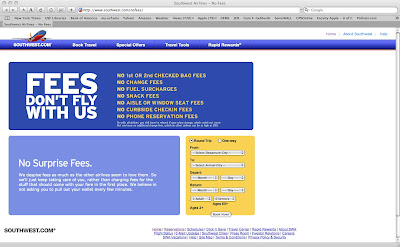
As I predicted, relying on rudimentary game theory, Southwest Airlines has responded with competitive gusto!! Rather than talk about it, I'll just offer the following evidence. Enjoy!

Southwest Airlines Newspaper Advertisement


Southwest Airlines' Website:

Southwest Airlines' Television Advertisements:

Flight Attendant 


Coins

Friday, May 30, 2008

Two recent profiles

I still vividly remember, during my employment interviews at Frank Lynn & Associates in Chicago, when  John Henderson observed that I "was odd" because I downplayed my experiences while most interviewees overplayed their experiences. My recollection of his comment was something to the effect of "What's wrong with you?" After thinking for a second, I said something like "I'm from the Midwest. It's not cool to toot your own horn." He informed me that that was a rather odd strategy - particularly for a consultant. Frank Lynn & Associates hired me anyway and they were (mostly) very happy with their decision. (My tendency to be deadline driven freaked out a few people, initially, until they realized I always came through in the end and consistently exceeded clients' expectations.) 

Why share that story? Well, I wanted to share two recent profiles of me posted on the Internet, but somehow felt the need point out that I'm still struggling with the Midwestern notion of not bringing attention to myself. Oh well. I have a friggin Blog, for goodness sakes! So, John, I am getting better at promoting "Brand Me" - but I still feel weird about it. 

So, here we go. I have two new profiles of me that have popped up on the Internet! They're both pretty cool - if I do say so myself:-) 


Sunday, May 25, 2008

Achtung, Achtung: BMW, was machen sie?

I love BMWs. They drive great, they're solid and, quite honestly, I think they're worth the price. It really is the "Ultimate Driving Machine." 

But what's really been driving me crazy for the past 2+ years is the lack of diesel BMWs in America. Ironically, BMW sells far more diesel-powered that regular gasoline automobiles, even when you include American sales. The reason BMW has not yet introduced diesel models in America is our strict emission regulations - particularly in California. But BMW finally has a solution: BluePerformance. They're planning on launching diesel versions of 335d and X5 in the Fall of 2008. 

Besides the delay - I assume due to engineering the new BluePerformance technology into the vehicles - what's making me a little nuts is that BMW is missing a HUGE opportunity in the United States by only introducing these two, very powerful vehicles. Yes, BMW has gotten kudos for their reduction in CO2 emissions and having fairly fuel-efficient cars. But their obsessive belief that BMW-buying Americans only care about speed and power is clouding their vision. Every customer is NOT obsessed with having the fastest or most powerful car. Some of us actually like having a car that's fast enough, powerful enough, but really incredibly engineered and exhibits supreme handling as well. Yes, it's the "ultimate driving machine," but that doesn't need to be solely about the number of seconds it takes to go from 0 to 60. 

Here's my point. I read the most incredible article recently comparing a Toyota Prius and a BMW 520d in England. (The 520d is a 4-cylinder diesel not sold in North America.) The amazing finding? The BMW 520d had better gas milage than the Prius!!!  

Also, the BMW118d  recently won the "World Green Car of the Year" at the New York auto show, based on it's super low emissions and 47+ miles to the gallon efficiency. But we can't buy the 118d in America because, apparently, BMW managers are worried that we're too speed and power obsessed to buy it. (Also, it has a hatchback, which BMW hasn't figured out is now a good thing in America, in contrast to their experiences with the 318 years ago. That's surprising since BMW is selling a ton of Mini Coopers in the US - so they certainly have first hand experience suggesting that hatchbacks are not the kiss of death anymore in the premium segment.) 

So Americans are going crazy with rising gas prices, finally buying more cars than trucks and preferring small cars with excellent gas milage over big, heavy traditional boat-like cars. But no car company is serving BMW's traditional upscale market segment - yet. So why delay? BMW has the technology and a range of models NOW that address Americans' new found desire for efficiency. There are a whole bunch of us who can afford a BMW and would like a nice car that gets great milage. (I'm sorry, the Prius is awesome technologically, but I'm just not going to buy a car that looks and feels like a college engineering experiment.) 

BMW has a unique window of opportunity to really increase their market share in America and simultaneously do the right thing - help us conserve energy. They can still sell their high powered, super fast cars as well (such as the 1-series with the 3-series 6-cylinder engine designed for America), but give us a choice. If nothing else, why not bring a bunch of the diesel powered cars to America and invite your customers to test drive them on an American city tour? How cool would that be? Plus, BMW would get first-hand feedback from current owners. Who knows, they might surprise BMW - and BMW might surprise BMW owners. And how great for the BMW brand to be known as the ultimate driving machine on all dimensions: awesome to drive, superior engineering, efficient and green as well? That value proposition seems perfect for a large portion of BMW's target market in America.  

Please BMW, I love your cars. Is it too much to ask to let me buy one that I can enjoy filling up as much as I enjoy driving?  

Prediction: American Airlines's Chaos-Causing Baggage Fee

Wow, just when I thought the "major" airlines couldn't screw up the business anymore, American Airlines has proved me wrong by instituting a $15 per piece baggage fee.  This is an idea straight out of an Excel spreadsheet designed by a newly-minted MBA with no concept of value propositions or game theory. 

I can totally see how the baggage fee looks brilliant at first blush. The baggage fee is not shown on the ticketing websites and, therefore, presents an opportunity to add an additional fee on top of the airfare, which is salient when people choose a carrier/flight. Basically, American Airlines (AA) can price at perceived parity with their competitors, but then grab an extra $15-30 of revenue when the customer checks in. If no other carrier follows suit, AA can effectively charge $15-30 more per comparable flight without losing many customers by decoupling the total fee from the salient time-of-purchase posted price. 

So, what's wrong with this approach? Well, three things. First, this kind of shenanigan is perfectly transparent and screams of "gotcha capitalism" - which really honks people off. My favorite (or least favorite, to be consistent) version of this is hidden hotel fees. The most exorbitant are city/state taxes/fees - particularly in New York City, Chicago and San Francisco - and are not included in the price quote when you make a reservation. I blame silly politicians for this bait and switch concept of sticking it to the tourists and business travelers - which I've got to believe has a long term negative impact on tourism (i.e., "I hate getting a hotel in New York because the actual price is oftentimes 50% more than the quoted price").  But the really maddening fees are the "safe fee" and the "gym/spa fees" which previously were included in the price of a room. Now hotels do this really slimy thing where they don't include the fees in the original price quote/reservation, but charge you for various sundries when you check out. If you say nothing, you get screwed. But even if you try fighting these hidden gotcha fees, it's hard to win the argument. Assuming no other airlines are silly enough to institute a baggage fee, people's attitudes toward the AA brand will decrease and AA's ability to charge pricing premiums or realize higher choice rates based on their brand name will decrease over time. I'm guessing that notion isn't in the MBA's awesome baggage surcharge spreadsheet. AA might lose a lot more than it gains by instituting the baggage fee.  

The second reason this is a bone-headed move is that if you look at the outcomes from a competitive standpoint, none of the three most likely competitive reactions are net cash flow positive over the long term. The competitive reaction AA is most likely hoping for is that no other carrier implements the baggage fee and, thus, AA charges a net higher fee for all its flights than competitors for comparable routes. But that doesn't take into account the damage to the AA brand - which will likely increase pricing sensitivity toward the AA brand and also lower consumers' a priori preference for AA, meaning they'll sell less tickets when they go head-to-head against other carriers. The next most desired outcome for AA is probably that all the major carriers match AA's move and, thus, every carrier can charge more for their tickets than they do now. But so what? By going first, AA hurts its brand and risks that others won't follow. Even if we assume that the impact on AA's brand is minimal and other carriers follow, AA has just created the same prisoner's dilemma they created with their frequent flier program: if every carrier implements the same policy, AA has no advantage over the others. But what I hope happens, and is certainly possible, is that Southwest or JetBlue will start running ads that focus on "our price includes everything, including your bags."  Or even better, "Why pay extra for your bags on AA if we're more likely to get them to where your going for free?" (I really like that one, but don't have time to see if Southwest or JetBlue do a better job at getting bags to the same place as passengers.) The bottom line of this will be that AA will need to rescind their baggage fee - which will have a net cash flow negative impact by (a) hurting the AA brand equity, (b) incurring significant set-up and tear down costs for the program and (c) enhance the brand image of competitive carriers. None of these likely outcomes is a net cash flow positive for AA. 

OK, the worst part of AA's baggage fee policy will be to make air travel even more unpleasant than it already is - which is stunning!! First, I'm getting sick to my stomach just imagining all of the "amateur" travelers holding up the check-in lines at airports arguing about the baggage fee, explaining they don't have the money on them to pay for the fee, and generally spreading bad Karma everywhere. That should really help ticket agent turnover - assuming you're trying to make it higher!! Second, as if making the seats smaller as Americans keep getting bigger wasn't awful enough  (another bone-headed Excel spreadsheet decision attempting to maximize capacity), AA has just significantly increased the insanity of passengers taking everything they own into the cabin. Every flight I can remember over the past five years that was 80% full included flight attendants racing around like they were playing some insane whack-a-mole game trying to shove baggage into overhead compartments, which oftentimes ends by tagging a few gigantic bags for jetway luggage handling before the plane could take off. In fact, I almost always check my luggage and just take my laptop briefcase with me anymore because I just don't want to deal with all that chaos on the plane. 

So what's the likely impact of AA's new baggage fee inside the cabin? More people carrying more crap onto the jet that clearly won't fit. More aggravation for travelers. More aggravation for flight attendants and pilots. And more delays. When AA loses baggage that they've now charged extra for (and they will, because there's always some chance baggage gets lost/incorrectly routed), they'll be hell to pay by travelers who paid $15 to not have their bag show up at their destination. 

And heaven forbid the other airlines follow suit with a baggage fee - we can all look forward to even more unpleasant experiences flying in America. I, for one, wish we had better trains in America because I just can't stand flying anymore - and it's only going to get worse until some airline wakes up and figures out that there is a HUGE opportunity in making flying a pleasant experience again. (And, please, make the seats bigger too.) 

Thursday, May 15, 2008

Why Obama is the Candidate Most Likely to Create Change in Washington

A few years ago my colleagues and I studied how organizations create a greater market focus. One of our most striking findings was that change begins with a new leader who is focused on improving organizational processes – rather than focusing on a discrete monetary or market-share goals. Successful leaders focus on imbuing their organizations with six key values: trust, openness, keeping promises, respect/empathy/perspective taking, collaboration, and the market as the raison raison d'ĂȘtre

Leaders forced organization members to interact and create a shared understanding of the market by sending cross-functional teams into the market (e.g., a purchasing agent, engineer and shop floor worker would visit customers and distributors together). By focusing on common experiences and a shared understanding of the market, organizations became more market-focused and, thus, more successful than before. Perhaps the best-known example of such a transformation occurred at Harley-Davidson Motor Company, which narrowly escaped bankruptcy in the 1980s to become one of the most successful American manufacturers in the 1990s and continues to exceed expectations today.

There are striking parallels between our research and the two remaining Democratic candidates. Hillary Clinton’s style is consistent with the notion of a mythical, all-knowing leader who provides all the answers for fixing an organization – a style we found unlikely to create positive organizational change. Hillary Clinton and the media consistently comment that she has more detailed policy positions and she vociferously defends those policy positions as unambiguously better than Senator Obama’s positions. Ironically, there appears to be an implied assumption that President Hillary Clinton would implement better policies and could do so because of the harsh lessons learned from her health care efforts in the early 1990s. Yet, she continues to insist that she somehow has greater insight and better answers than anyone else. This begs the question if she has, in fact, learned from her earlier failures.

Conversely, Barack Obama’s style is consistent with successful change leaders: someone who gets people to focus on common issues and who realizes that the process of agreeing on a shared understanding of a situation will lead to greater cooperation, trust and success. Whereas Senator Clinton focuses on explaining that her policies are better, Senator Obama is focused on fixing the process of developing and implementing solutions. Although some may see this as a weakness for Senator Obama, our research suggests that his approach is more likely to be successful at creating change because it allows other people to participate and take ownership in the change process.

Differences between the candidates’ styles appear fairly stable and, thus, allow voters to project which candidate is more likely to actually move America in a positive direction. Senator Clinton is well known for her ability to “fight.” Whether comparing herself to the fictional character Rocky in Philadelphia or committing to “fight” for voters in Ohio, the common theme is her tenacity in fighting for what she believes in. Unfortunately, in spite of her tremendous intellect and grasp of policy details, it’s absurd to assume she has all the answers. Furthermore, which Americans would President Hillary Clinton fight with, exactly? The role of President is to lead everyone: Republicans, Democrats, Greens, Libertarians, and independents. Historically speaking, it’s difficult to comprehend how a President who is committed to fighting with members of Congress can accomplish much at all. Sure, with majorities in the House and Senate, a President can force through controversial legislation, but that won’t change the tone in Washington. Additionally, as President Bill Clinton discovered in 1994, it can have disastrous effects in the next election cycle.

In contrast, Barack Obama has a long history of working with competing interests to find acceptable compromises that everyone can agree on. Biographical sketches of Senator Obama have included interviews with colleagues who joke that Senator Obama’s approach of hearing everyone’s opinion before working on a common solution drove them a little crazy – but it worked. Although on a much larger scale, that community organizing approach – premised on respecting the inherent dignity of every person and listening to everyone’s concerns – bodes well for an effective commander in chief. Senator Obama’s personal history as the son of an African father and a white, American mother who later married an Indonesian man appears to have nurtured his ability to empathize and understand a wide array of viewpoints, which has become extremely honed throughout his life. Senator Obama’s speech on race relations was an astounding example of his ability to empathize – and truly understand – the perspectives of both white and black Americans.

Senator Obama shares three other characteristics with successful change leaders: honesty, authenticity, and a willingness to admit he was wrong. Although empathy, honesty, authenticity and a willingness to admit one is wrong are not all that’s needed for a successful leader – but it’s certainly the first step in being able to work openly and honestly with a wide range of people to create shared understandings and work on effective solutions.

The characteristics of successful leaders in business transformations appear to be the same ones this country could use in moving us forward. When choosing a company president to transform a company, shareholders are better off choosing a leader rather than a fighter. That’s something the Democratic Party and America should consider as we choose a President for all of us. 

Tuesday, December 18, 2007

Christmas Presents in the Spirit of Christ(mas)

Well, it's that time of year again: Christmas.

It's the one holiday - particularly in America - that makes my head hurt.

Why?

Well, without going into all the particulars about the origin's of Christmas (
see Wikipedia.org for a rather quick overview), which is enough to make one's head hurt, let's just stick with Christmas as the celebration of the birth of Jesus Christ, Lord and Savior and Son of God.

Jesus was sent by God to save the world from its sins. One of the
really big sins - based on all the stories and allegories in the New Testament - was/is materialism. The wanting/lusting/accumulation of wealth and goods on Earth - particularly when so many people go without.

So what has happened to Christmas in American Culture? Well, we
SHOP!! We buy so much that Marketers call the Friday after Thanksgiving "Black Friday" - meaning that's the day most retailers actually go into the black (i.e., start making money).

This year, during Thanksgiving dinner with friends, I was astounded that Katie (18-year-old daughter of Julie and Terry) had to be up at 4AM to go work at Circuit City. They were opening at 5AM or 6AM on Friday. I saw ads for JC Penny's that they were opening at 4AM or 5AM on Friday. Why are they opening so early? Well, to beat the (now) annual ritual of throngs of people, literally, beating the shit out of each other to get into Wal-Mart stores at their 6am Friday openings - for fear all the really good deals will be gone. (Since moving to Florida, I've become much more sensitive to this ritual, as the really amazing violent film footage - shown nationally - is invariably from a store in Florida.)

Of course, the insanity of a large portion of the populace might seem like a religious ritual taken a tad too far - except that I don't get the sense that all of those fanatical customers beating their fellow consumers to get into their neighborhood Wal-Mart are doing it because "That's what Jesus would do." No, they're doing it because: (1) they think they can - and should - buy the affections of their loved ones with material gifts, (2) they hope to get even better gifts in return (unless they're passive-aggressive, in which the entire point is to humiliate fellow gift-givers by "out gifting" them), (3) they can't actually afford to be buying all these gifts, but feel they have to, and therefore need to minimize the expense, and/or (4) they see the entire holiday season as a sport in terms of time, effort and expense, with the goal being to outdo everyone else - or at least the average gift-giver.

Sadly, marketing and business have a lot to do with the evolution of Christmas from a celebration of friends, family and (if you're Christian) the arrival of Jesus, to one of the most materialistic and insanely competitive times of the year. As Max Weber pointed out in
The Protestant Ethic and the Spirit of Capitalism (1930):
Since asceticism undertook to remodel the world and to work out its ideals in the world, material goods have gained an increasing and finally an inexorable power over the lives of men as at no previous period in history. Today the spirit of religious asceticism…has escaped from the cage. But victorious capitalism, since it rests on mechanical foundations, needs its support no longer…

For of the last stage of this cultural development, it might well be truly said: Specialists without spirit, sensualists without heart; this nullity imagines that it has attained a level of civilization never before achieved.
Well, if Max Weber only knew how much worse it would get.

So, the point is this: If the goal is to celebrate the birth, life and teachings of Jesus Christ, rather than heaping presents on others - wouldn't it make a bit more sense to take care of those less fortunate? Instead of buying, buying, buying (often on credit) and hoping to get, get, get - how about taking the opportunity to share the act of giving to those less fortunate with our friends and family?

To this end, rather than the insanity of trying to figure out what everyone would like this year - and usually getting it
right enough to seem nice, but wrong enough to disappoint - I've decided to donate $500 to the following causes in the Spirit of Christmas:
Make It Right New Orleans
This is group that Brad Pitt has been leading to build affordable and sustainable housing in the Lower 9th Ward in New Orleans. The premise is for people to donate money to build 150 affordable houses (at $150,000 each) that will be given to the families who lost a house in Hurricane Katrina.

Gift: $200 Ceiling Fan for a house being donated to a family in New Orleans (as everyone knows, I love ceiling fans).

One Laptop per Child
Given the importance of education in changing the world, I can't imagine a more wonderful and worthwhile mission than that of
One Laptop per Child: "....to empower the children of developing countries to learn by providing one connected laptop to every school-age child. In order to accomplish our goal, we need people who believe in what we’re doing and want to help make education for the world’s children a priority, not a privilege."

Gift: $200 to buy one laptop for a child.
(OLPC is also running a "promotion" that, for $400, you can buy two laptops - one is shipped to you and the other is donated to a child via the program.)

Wikimedia Foundation, Inc.

As the foundation supporting
Wikipedia.org - the internet's free community-edited encyclopedia - Wikimedia's mission is to: "....empower and engage people around the world to collect and develop educational content under a free content license or in the public domain, and to disseminate it effectively and globally." I confess, I LOVE Wikipedia.org. It might not always be right, but it is a quick way to find stuff when I'm in a hurry and need to get a "quick hint" about something I've forgotten or generally clueless about. Plus, it's available in a number of languages and it makes that laptop I just donated much more useful!!

Gift: $100
I don't know if that's actually what Jesus would do. But as a Unitarian Universalist - it's what I think he would want us to do.

So that's it for now.

Give everyone you love a big hug this holiday season (and more often, if you're up for it) and have a happy and wonderful holiday season!!

Friday, July 21, 2006

Is Amazon.com Sears of the 21st Century?

What the hell happened to Amazon.com? They seem destined to become the Sears of the 21st century.

Selling books and CDs aren't enough - now they sell groceries, diapers, band saws and car tires (really). Just like Sears during the 1980s, 1990s and into their glorious redemption by K-Mart, Amazon.com is becoming so unfocused and crappy at everything, I think they're goin' down! You'll know they're in trouble when you see the catchy slogan, "The Softer Side of Amazon.com."

What has really honked me off is that I needed a copy of Ray Anderson's "
Mid-Course Correction: Toward a Sustainable Enterprise: The Interface Model" for a book club kind of discussion group Walt Nord is hosting at USF. This is not your typical Barnes & Noble or Borders shelf stocker, so I ordered it and a copy of "The Chicago Manual of Style, 15th edition" from Amazon.com (just in case editing had completely changed since the 14th edition...apparently it hasn't).

The two books combined qualified for Amazon's "Free Shipping," which I don't like since the books never seem to arrive (you get what you pay for). Since I was ordering them on Wednesday July 12th and the book group was meeting on Firday, July 21st, I figured I should really pay for the shipping to make sure I get the book on time. Ironically, I thought about paying for 2-day shipping, but then I realized that would be alot more money and if there was a problem with the order (serious Alfred Hitchcock forshadowing), I'd be pretty pissed paying $10 or whatever to not get the books on time.

Well, well, well. What do you think happened? I couldn't make stuff like this up because it's just too crazy.

On Wednesday, July 12th I placed the order for two books that were in stock and "usually ship within 24 hours."

On Thursday, July 13th, I was initially surprised and pleased to see my order was being place with DHL. OK, it's not FedEx or UPS, but DHL is good too - no? The books were shipped from Allentown, PA, which is 1,108 miles from Tampa, FL. Amazon.com estimated a delivery date of Thursday, July 20th, which seemed like a pretty conservative estimate. I mean, even if it were coming via the US Postal Service, that distance is pretty reasonable for a one week delivery. DHL's gotta be quicker than that. Since I was going out of town Thursday through Sunday, I was a little nervous that the books might be delivered before I got homw.

Well, no update to the Amazon.com/DHL tracking until Sunday night, July 16th. The books were now in March Air Force Base, Riverside CA!!! WHAT??
My books went from Allentown, PA on Thursday and apparently took a 2,666 mile Greyhound Bus trip to March Airforce Base in Riverside California. (Look, a plane would have gotten there in a day. Three days? That's a Greyhound bus or Amtrack!)
The books were now 2,473 miles away from Tampa. In other words, in three days, the books had traveled 1,365 miles further from me than they were on Wednesday.

Hey, but it's DHL, right? Maybe they're like FedEx and they ship all their stuff to a central hub (California doesn't seem very central, but I'm no logistics genius). I still don't know why the books are on an Airforce base, but I did some Googling (love that that's a verb) and found out some enterprising folks turned a decommisioned Airforce base into a semi-commercial venture. Well, let's see what happens next.

Well, on Monday, July 17th, the books must have been a little tired and thought, "Why come all the way to the West Coast without seeing the Pacific Ocean?" Or maybe, "Allentown was so dull and the warehouse so dark, let's go to the beach." I don't know. All I do know is somehow the books went 76 miles further West to Hawthorne, California, which appears to be very beachy based on Mapquest. Seems like an odd place for books to go. However, Hawthorne is close to LAX - so maybe they were trying to get on a commercial flight to get to my house. (I think they were totally trying to get the chicks in LA, but I suffer from attribution biases like that.) What still seems weird is why would you fly the books into March Airforce Base and then drive them ~75 miles to LAX? Wouldn't it be more efficient to fly them into and out of LAX? Whatever, I'm not a logisitics expert.

Tuesday, July 18th, no tracking update.

Wednesday, July 19th, no tracking update. (Those books must be taking full advantage of those Pacific Coast beaches!)

Thursday, July 20th, no tracking update.

OK, now I'm kinda freaking out. The book group meets on Friday and I don't even have the book. I panic and start searching to see if Barnes & Noble finally did the obvious and put their brick and mortor store inventories on-line. Amazingly, they haven't! Damn it! (This is soooo obvious as a way to leverage the on-line and bricks-and-mortor model. But then again, I'm no logistics expert.)

Hey Jeff Bezos, ever heard of a "promise by date?"
I ordered these books and paid for standard shipping so I would have them by this week.
However, it is Saturday morning and I still don't have the books.
The tracking number was useless - as it shows the books were shipped from Allentown, PA to Los Angeles, CA and then it stops there on the 17th of July (ironically on their way to Tampa, FL).

Since the PROMISE BY DATE was July 18-20 and I still hadn't received the book on July 21st, I called customer service, who informed me DHL handed the books off to the USPS, and I "should" get them by Monday. I would like my shipping costs refunded, since I obviously I am not getting the books any sonner than if I had done the "free shipping."

Saturday, February 04, 2006

"Us versus Them" Inside the Organization

I am fascinated by individuals' psychological processes defining groups of people. From a marketing, marketing strategy and organizational performance perspective, this process affects the assessment of other individuals, individuals' activities and the activities of the group. In an October 2005 post I explained how this process can blind marketers to the opportunities in front of them.

From a theoretical perspective, attribution theory is the most basic notion of this: individuals perceive they are successful because of their hard work and unsuccessful because of factors out of their control; but the successes of others are due to luck and failure is due to personal shortcomings. This notion has been extended to groups, with similar attributions occurring when people are randomly assigned to a group with no inherent meaning (e.g., the "blue" group). In my research on creating market-oriented organizations, every successful change included a redefinition of primary group membership from functional or other subgroup (e.g., accounting, west coast, executive-level) to the organization level. Specifically, everyone was part of the effort to make money by serving the needs of the market.

Well, it's been a tough week, because I've been distracted by a very real example of how important these effects can be for group cohesion and performance. Specifically, the faculty union is pursuing domestic partnership benefits and the administration is beginning to research the options. There was a story in the Tampa Tribune on this development and an op-ed written by USF Professor James Stock suggesting a limited pool of money exists at USF and providing domestic partnership benefits was less important than a number of better uses. If I didn't know Dr. Stock, I would never have known about his letter. The rub is I do know him. He's a full professor in the marketing department, whose office door is a virtual billboard for Christian events on campus and around Tampa. I'm an assistant professor in the marketing department, a
Unitarian Universalist and I happen to be gay. Juxtaposing our differences versus what we have in common highlights the importance of group definition within a larger group of people who have a set of common objectives.

Before going on, it's helpful to define the mission of USF. My understanding is USF is defined by two overriding goals: performing world-class research and facilitating learning and understanding through education. The best way to fulfill our mission is if every stakeholder's efforts are directed at contributing to that goal. Anything not contributing to that goal is a waste of resources and a potential threat to fulfilling our mission. That means every professor is working on world-class research and/or doing an exceptional job of educating people. Every "back stage" person should be focused on encouraging and supporting these efforts.

By defining USF by our common mission of research and education, rather than by college, department, location, tenure, role, etc., individuals within USF can work together much more efficiently and effectively toward our common goals. An exemplar of this approach is Alberto-Culver, which requires each and every person at the company to annually write and memorize their own Individual Economic Value statement, which ties the efforts of that person to the goals of the organization. Every person knows exactly how they contribute to the long-term profitability of the company by addressing the needs of the market. Harley-Davidson accomplishes this by incorporating their company mission and goals into each individual's annual plan. Everyone at Harley-Davidson knows how they fit into the organization and why what they do matters.

This brings us to domestic partnership benefits at USF. Would they contribute to accomplishing our common mission? How?

First, Dr. Stock states he opposes domestic partnership benefits on financial, rather than on moral or religious grounds. While not sure of the costs, he states no one else has offered cost estimates either. (There is a reason the Provost is looking into this, the cost/benefit tradeoff is complicated.
HRC offers some broad numbers showing significant returns for such benefits based on the experience of world-class companies.) Assuming there is a cost, Dr. Stock suggests the money would be better used elsewhere. Since Dr. Stock did not offer to give up USF's subsidy of healthcare, life insurance and other benefits for him and his family, I assume he specifically means providing healthcare benefits to domestic partners would be a suboptimal use of USF resources. If, indeed, he is suggesting that eliminating all benefits for spouses and family members would be a good idea, well, I don't agree. If we want to attract and keep world-class employees, I think family-related benefit packages are important. Fortune magazine's "The 100 Best Companies to Work For, 2006" certainly suggests that benefits are important for attracting the employees which make a company great. (There's also quite a bit about the importance of a common mission for achieving a common goal.) I assume we can all agree that benefits are an important attribute for highly sought after employees. Hence, benefits contribute to the mission of USF by attracting the best employees, all other things being equal.

Domestic partnership benefits do matter for gay people. Whether straight or gay faculty, considerations for moving to a new university and city include the impact on an entire family. For married people with children, these issues typically revolve around schools for the kids and finding an appropriate job for the spouse. For gay people, the lack of domestic partnership benefits makes the decision much more complicated. If my partner can't find a job in time, how will we pay for his health care? If he does find a job, what if it doesn't offer benefits? If USF doesn't offer domestic partnership benefits, how likely are they to help find him a job?

This is not a thought experiment. When I joined USF I was in a relationship with an assistant professor at the University of Chicago Medical School and one of the top three pediatric neuropsychologists in Chicago. We discussed the possibility of him moving here, whether as a professor at USF or building up a private practice in Tampa. The private practice option was too risky and complicated for us. Since I didn't have domestic partnership benefits, we'd have to find a third party to cover his health and insurance needs. Given he worked at one of the top medical schools in the world, finding him a position at USF would seem straightforward. Instead, we were nervous about how my colleagues would react and whether USF was open-minded enough to facilitate an interview. In spite of our concerns, we did pursue getting him a job at USF by asking people at the business school to route the information in the same way it does for straight couples. He also applied for/inquired about positions in a number of departments for both posted and the possibility of non-posted jobs. In every communication he explained our situation. None of my requests were ever formally acknowledged or formally or informally followed-up on. None of his inquires or applications were ever replied to. Given the lack of help from USF, we investigated options for me returning to Chicago or both of us getting a job at some third university. Since I was just starting out my academic career, we didn't get very far - I would not be attractive to other research universities until I established a track record. Today, he is in Chicago and we're no longer a couple. As relationships go, I can't pin the dissolution of our relationship on any one thing. But trying to build a life together in Tampa was hindered by the lack of benefits and other opportunities offered to straight employees and potential employees at USF. Domestic partnership benefits are important for attracting and retaining talent.

The final and most overlooked way partnership benefits contribute to USF's mission is the signal it conveys about what's important. If our
raison d'ĂȘtre is performing world-class research and facilitating learning and understanding through education, then everything the organization does, prints and supports should be judged against the mission. This means accolades and rewards are given to those who support that mission. Domestic partnership benefits equal to married couple benefits are a public acknowledgment that what matters to USF is research and education and how well employees perform or support those activities.

Conversely, when employees are treated differently for performing the exact same activities equally well, that suggests that we're not all really part of the group. It also suggests that what's important is not the stated mission of the organization, but some other hidden agenda. There is a long stream of cultural work in sociology and anthropology explaining how the symbols of a culture become disconnected from the underlying assumptions of that culture and the impact. Within an organization's culture, this decoupling leads to dysfunctional activities and political rivalries which waste time, effort and impede achieving the mission of the organization and, typically, the goals of any one subgroup.

Regarding USF, offering some benefits to straight employees and not gay employees sends a signal that gay employees are not as desirable or important as straight employees, all things being equal. It creates group differences that conflict with the stated mission of the organization. (This extends far beyond domestic partnership benefits. When people are recognized for the length of their employment rather than continuing to publish in A-journals or the number of careers they've launched, it sends a signal that "hanging on" matters. When tenure is seen as a reward for past research rather than a license to engage in more risky or controversial research, it sends a signal that history is more important than active research. )

So what? Well, research is pretty clear on what happens. Given the chance, employees who were attracted to the epoused values of an organization, but find the values-in-use are different, will leave in pursuit of an organization that better fits their goals. Ironically, for those people who do not care about the espoused values or can not leave - they end up staying. That's how organizations implode.

The people who leave will go off to find an organization that better matches their objectives and an organizational culture that values them and their colleagues as people contributing to a common goal. Perhaps the most encouraging and insightful moment this week occurred when a straight colleague offhandedly commented on being one of the 20 people who wrote to the Provost in support of the benefits. I hadn't written, but this person had. This is an example of how such signals are not only important to the explicitly marginalized group, but to people who see it as a signal regarding what's important to the entire organization.

Now on to how all this ties together. Since I found out about Dr. Stock's Tampa Tribune op-ed piece, I can't help but be bothered. The day before, Dr. Stock had mentioned working together on a project. I was excited. We were colleagues with overlapping interests and talents and common goals who would work on something that leverages what is different about us. However, after reading the op-ed piece, I feel very uncomfortable. I sense there might be a limited pie and I need to get mine instead of assuming the system will make sure things are equitable. In his op-ed piece, Dr. Stock clearly stated his view that my partner's health and safety are less important than his wife and family's health and safety and less important than a myriad of other under funded opportunities on campus. If my personal life is categorically less important than any straight researcher's personal life, I question what kind of a place I'm working at. I came here to do research and help people learn. It turns me on. That's what I thought mattered at USF as well. Now I feel like some kind of second-class citizen in an organization that wants and expects world-class research and education, but would prefer it from straight people.

In closing, I had not written my support for domestic partnership benefits to Provost Khator because I felt too overwhelmed with my research and teaching to write a cogent letter. Reading Dr. Stock's op-ed piece has taken away far more time and effort than writing Provost Khator would have ever taken. Having my colleagues talk about his op-ed piece has been equally distracting. Thinking about all this, getting aggravated and feeling generally marginalized as a member of USF has been both distracting and depressing. I can't imagine working any harder on my research or my classes. If I am to be judged and rewarded not by the outcome of that work, but by whom I love, perhaps I need to find an organization that does value me as a person and judges me by my performance. And that is a very real example of how group definitions within an organization impact achieving the organization's mission and, specifically, why domestic partnership benefits are important for those of us interested in fulfilling the mission of USF.

P.S. If you are part of the USF family and you believe domestic partnership benefits matter in what we're collectively trying to accomplish as a university, I suggest you share your thoughts and opinions with Provost Khator and President Genshaft.